2026年07月23日

2026.04.27
Combining the AI drug discovery support service, Drug Discovery AI Factory, with the technological and research capabilities of academia to strengthen Japan's drug discovery capabilities through close collaboration between dry and wet research
Tokyo, Japan, April 27, 2026 - FRONTEO, Inc. (Headquarters: Tokyo, Japan; President & CEO: Masahiro Morimoto; hereinafter “FRONTEO”) and Institute of Science Tokyo (Tokyo, Japan; President and Chief Executive Officer: Naoto Ohtake) have announced the opening of the FRONTEO AI Drug Discovery Ecosystem Collaborative Research Cluster (the “Cluster”) on 1 April 2026, at the Yokohama Campus of Science Tokyo.
This Cluster will integrate FRONTEO's Equation-driven AI, KIBIT*1, with Science Tokyo's advanced technologies, such as the PLOM-CON analysis method*2 and Cell-resealing technique*3, at the same location, making it possible to perform everything from hypothesis generation to experimental verification in a single integrated workflow. FRONTEO aims to promote social implementation of cutting-edge technologies in the field of AI drug discovery and to create drug discovery innovations originating in Japan. Today, April 27, the two parties held a signing ceremony.

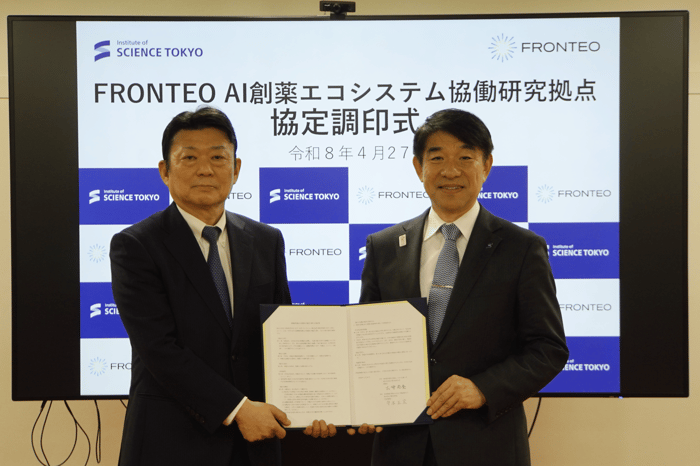
(Left) Masahiro Morimoto, FRONTEO president and CEO;
(Right) Naoto Ohtake, President and Chief Executive Officer, Science Tokyo
Collaborations to date and the establishment of the Cluster
FRONTEO and Science Tokyo have been deepening collaboration through joint research on disease structure analysis and drug target discovery since 2022*4,5. Based on the results to date, the entities decided to establish the Cluster in order to promote full-fledged collaboration from basic research to social implementation.
Drug Discovery Hypothesis Testing Loop Realized by the Cluster
To make the current drug discovery ecosystem competitive, it is necessary to organically link AI-based target molecule*6 search and hypothesis generation (dry research) with experimental verification using cells and living organisms (wet research). At the Cluster, FRONTEO will extract drug target molecule candidates and construct hypotheses on their mechanisms of action using the AI KIBIT (dry research), and Science Tokyo will rapidly conduct experimental verification (wet research). Furthermore, by returning experimental results to AI analysis again, the process aims to achieve a highly effective hypothesis-testing loop that cycles between hypothesis generation and validation, and dramatically improve the probability of drug discovery success.
Creation of New Value Through the Cluster
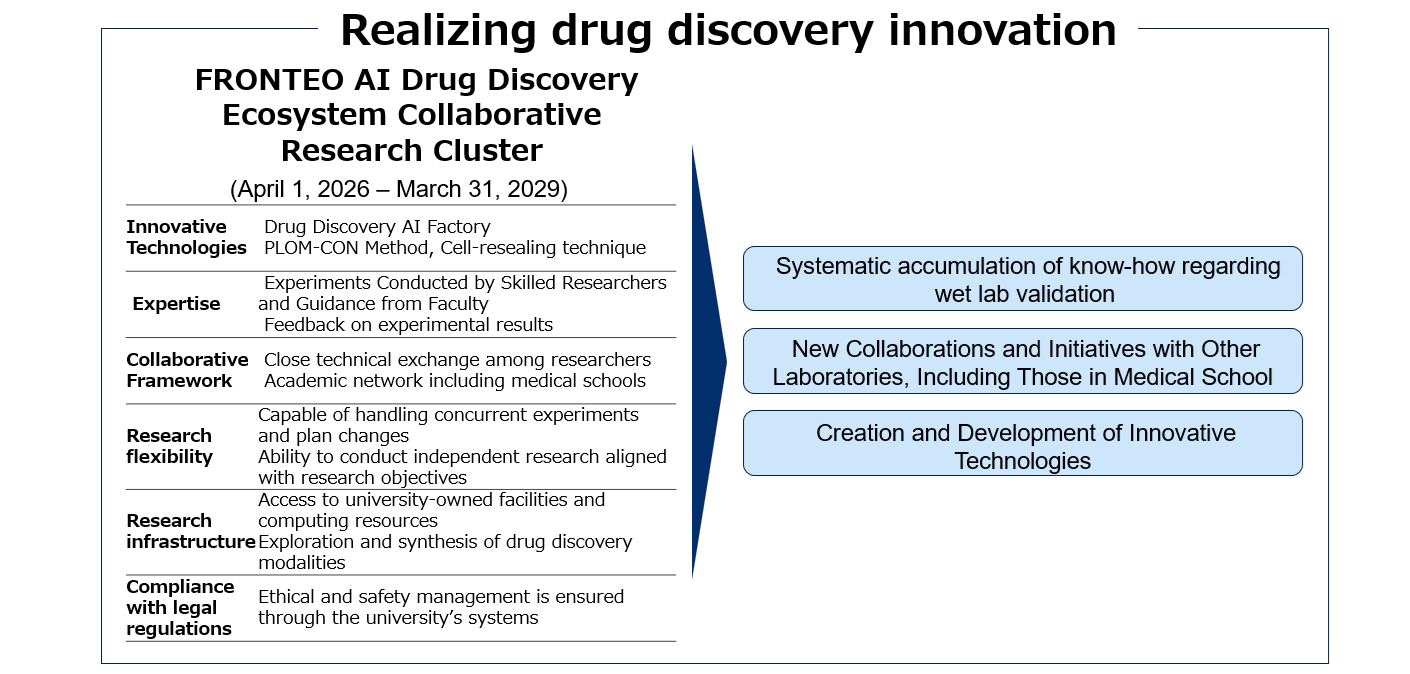
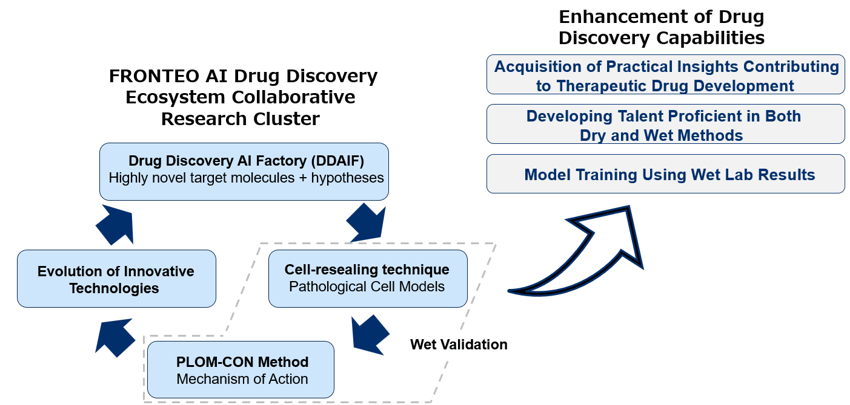
The Cluster is expected to provide value to the institute by establishing a mechanism to link research results to social implementation, to the pharmaceutical industry by acquiring high-quality drug seeds based on a sophisticated understanding of the mechanism of action and biological systems, and to society by creating innovative treatments and medicines.
Joint research will target disease areas with high unmet medical needs*7, including oncology. The Cluster will consider the development of promising drug seeds discovered in research with a view to out-licensing*8. FRONTEO will consider acquiring all or part of the intellectual property rights to any inventions, etc., obtained in the research upon consultation with Science Tokyo.
Innovative Technologies Supporting the Cluster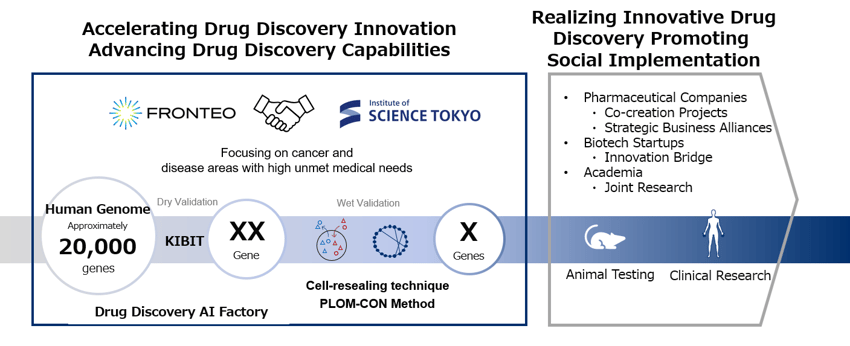
FRONTEO Technology: KIBIT, an Equation-Driven AI Enabling Discontinuous Discovery
FRONTEO's AI drug discovery support service, Drug Discovery AI Factory (“DDAIF”), combines the knowledge of drug discovery researchers and AI engineers with KIBIT as its core engine. General natural language processing AI and knowledge graphs make inferences based on continuous connections such as “A is related to B” and “B is related to C.” However, this serial discovery approach makes it difficult to lead researchers to the new discoveries they seek. KIBIT is capable of predicting discontinuous associations between diseases and genes that are not directly described in literature through a unique equation, and this technology has been patented in Japan, Europe, and the U.S. As a previous achievement of DDAIF, in pancreatic cancer research, it extracted 17 candidate target molecule genes from among approximately 20,000 human genes and confirmed through in vitro testing that six genes inhibited the proliferation of pancreatic cancer cells. In addition, the target search process, which previously took approximately two years, has been reduced to two days.
Science Tokyo Technologies: PLOM-CON Analysis Method and Cell-resealing Technique
Science Tokyo is one of Japan’s leading research institutions and was recognized as a University for International Research Excellence by the Ministry of Education, Culture, Sports, Science and Technology in January 2026*9. The research group led by Masayuki Murata, Specially Appointed Professor at the institute, has developed innovative technologies for understanding and controlling cellular functions.
The PLOM-CON analysis method is a novel approach for deciphering cellular states by quantitatively analyzing protein dynamics, including changes in protein levels, quality, and spatial localization within individual cells. Unlike conventional static analyses that capture only snapshots of molecular information, PLOM-CON applies dynamic network analysis to reveal coordinated fluctuations across the cellular system. This enables early detection of cellular state transitions, including disease-related changes before the appearance of clear phenotypes, and facilitates the identification of novel therapeutic targets and mechanisms of action.
The Cell-resealing technique enables direct manipulation of intracellular environments by temporarily opening the cell membrane, replacing or introducing specific proteins and molecular factors, and then restoring the membrane integrity. This technology allows researchers to experimentally reconstruct cellular states and investigate disease-associated processes that normally develop over years, within a short laboratory timeframe.
Together, these technologies provide a powerful platform for next-generation cell science, drug discovery, and disease prevention.
Comments
Dr. Masayuki Murata, Specially Appointed Professor, Cell Biology Center, Science Tokyo and Director, FRONTEO AI Drug Discovery Ecosystem Collaborative Research Cluster:
Through our collaboration with FRONTEO, we have discovered the strong potential of integrating FRONTEO’s equation-based AI technology, KIBIT, with our advanced cell science platforms. At the collaborative research cluster, researchers with expertise in both computational (“dry”) and experimental (“wet”) approaches continuously exchange ideas, analyze data, and validate findings. This iterative process creates new hypotheses and accelerates scientific discovery. I believe this integrated approach represents a prototype for next-generation drug discovery, overcoming the uncertainty inherent in conventional research methods and significantly increasing the success rate of identifying effective therapeutic strategies.
Dr. Hiroyoshi Toyoshiba, Director/CSO (Chief Science Officer) and Deputy Director, FRONTEO AI Drug Discovery Ecosystem Collaborative Research Cluster:
As the use of AI in drug discovery research continues to advance, it is essential to strengthen the cycle of validating AI-generated predictions through cell and animal experiments and feeding those results back into AI analysis to improve the probability of success in drug discovery. We are very pleased to be working with the outstanding researchers at Science Tokyo to accelerate drug discovery to meet unmet medical needs through the fusion of our technologies and the creation and development of new technologies. In addition to promoting FRONTEO's own drug discovery research, we will contribute to strengthening Japan's drug discovery capabilities and create innovative medicines originating from Japan.
Notes:
*1 equation-driven AI “KIBIT”: An artificial intelligence independently developed by FRONTEO. By utilizing mathematical equations, KIBIT enables discontinuous discoveries, identification of causal relationships, and highly accurate, reproducible analyses. Its lightweight learning process allows it to operate on a single personal computer. Patents have been granted in Japan, Europe, and the U.S.
*2 PLOM-CON analysis method: An analytical method that elucidates cellular states associated with signal transduction, diseases, and drug efficacy by examining quantitative changes in protein expression as well as qualitative and spatiotemporal (subcellular localization) changes within individual cells.
Reference: Science Tokyo: Construction of Protein Covariation Networks from Cell-Staining Images — A New Analytical Method for Capturing Cellular States Expected to Accelerate Drug Discovery, https://www.titech.ac.jp/news/2021/061334
*3 cell-resealing technique: A technology that replaces intracellular proteins and other factors to create cells with new functions. It is used, for example, to rapidly reproduce disease models and evaluate drug efficacy.
*4 September 29, 2022, press release: FRONTEO and Tokyo Institute of Technology launched a joint research project to improve the efficiency and speed of drug target discovery, https://www.fronteo.com/20220929
*5 May 13, 2025, press release: FRONTEO and Science Tokyo launched a joint research project to identify novel drug targets using the “Drug Discovery AI Factory”, https://www.fronteo.com/news/pr/20250513
*6 target molecule: The molecule (gene) that a drug is designed to act upon.
*7 unmet medical needs: The need for new drugs, therapies, or treatment approaches for diseases for which effective treatments have not yet been established.
*8 out-licensing: In the pharmaceutical industry, drug development may be conducted either internally or through the acquisition of development and commercialization rights from external organizations. In the latter case, “out-licensing” refers to the granting or transfer of such development and/or commercialization rights by the originating company or institution to a pharmaceutical company.
*9 Ministry of Education, Culture, Sports, Science and Technology: Designation of University for International Research Excellence, https://www.mext.go.jp/b_menu/houdou/mext_01598.html
About FRONTEO Drug Discovery AI Factory (DDAIF)
[Reference: Initiatives with pharmaceutical companies and Academia]
https://www.fronteo.com/news/ddaif-list
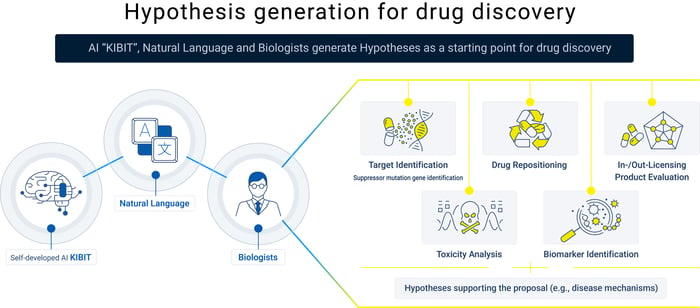
FRONTEO Drug Discovery AI Factory (DDAIF) is an AI-based drug discovery support service that combines KIBIT (patented in Japan, Europe, the U.S., and South Korea), an Equation-driven AI specialized in natural language processing, with the expertise of FRONTEO’s drug discovery researchers and AI engineers. It powerfully supports researchers’ decision-making in drug development through the analysis of disease-related gene networks and the construction of hypotheses regarding target molecule candidates. This service has already been adopted by multiple major pharmaceutical companies and has a proven track record.
*The technology used in Drug Discovery AI Factory is covered by a total of 21 patents held by FRONTEO in Japan, Europe, the U.S., and South Korea.
https://lifescience.fronteo.com/products/drug-discovery-ai-factory/
About FRONTEO, Inc. https://www.fronteo.com/en/
FRONTEO provides its proprietary Equation-driven AI "KIBIT" to support the judgment of experts in various fields who face social challenges day and night, and creates the starting point for innovation. Unlike general-purpose AI, its unique natural language processing technology (patented in Japan, Europe, the U.S., and South Korea) enables high-speed, high-precision analysis without reliance on training data volume or computational power.
Additionally, patented technology that maps (visualizes structure) analyzed information allows KIBIT to directly influence expert insights, and in recent years, KIBIT has been applied in hypothesis generation and target discovery for drug development.
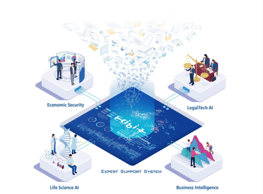
Guided by its mission to enhance fairness in the information society by uncovering opportunities and risks hidden in collective intelligence, FRONTEO promotes social implementation in life sciences AI, risk management (including economic security, business intelligence compliance support, business intelligence professional support and legaltech AI), and digital transformation support (Alnetz Inc.).
Founded in August 2003, FRONTEO was listed on the Tokyo Stock Exchange Mothers Market (now the Growth Market) on June 26, 2007. The company has offices in Japan and the U.S. As of March 31, 2026, FRONTEO’s capital stands at 915,057,000 yen.
*FRONTEO, KIBIT, and Drug Discovery AI Factory are trademarks or registered trademarks of FRONTEO in Japan, Europe, the U.S., and South Korea.