2026年11月11日

2026.11.12
Leveraging the AI-Driven Drug Discovery Support Service “Drug Discovery AI Factory” to Support the Research, Development, and Global Expansion of Regenerative Medicine Products
Tokyo, Japan, November 12, 2026 - FRONTEO, Inc. (Headquarters: Tokyo, Japan; President & CEO: Masahiro Morimoto; hereinafter “FRONTEO”) announces that it has launched a project with Human Life CORD Japan Inc. (Headquarters: Tokyo, Japan; President & CEO: Masamitsu Harada; hereinafter “Human Life CORD”) to analyze the mechanisms of action of cell therapy products developed by Human Life CORD using umbilical cord-derived mesenchymal stromal cells (UC-MSCs)*1. The research will utilize FRONTEO’s AI-driven drug discovery support service “Drug Discovery AI Factory” (hereinafter “DDAIF”).
This project will be conducted as part of “DDAIF Innovation Bridge,”*2 FRONTEO’s initiative to support innovation in drug discovery. By deepening scientific understanding of the mechanisms of action of cell therapy products, the two companies aim to advance research and development and promote efforts toward commercialization in Japan and overseas.
Background of the Project
As populations age in Japan and around the world, addressing chronic and age-related conditions, such as diabetes and sarcopenia (age-related loss of muscle mass and strength), has become an increasingly important medical challenge. Cell therapies using mesenchymal stromal cells, which exhibit a range of functions including immunomodulatory, anti-inflammatory, and tissue repair-promoting effects, are attracting growing attention as potential new treatments for these conditions.
Unlike pharmaceuticals that act primarily on specific target molecules, cell therapies are thought to involve multiple interacting factors, including various bioactive substances produced by cells and interactions with cells and tissues in the body. Consequently, elucidating the mechanisms of action underlying their therapeutic effects is challenging and remains an important issue in the research, development, and commercialization of cell therapy products.
Against the backdrop of both the potential and the challenges of cell therapy, Human Life CORD is engaged in the research and development of regenerative medicine products using UC-MSCs derived from umbilical cords sourced in Japan. Based on cell manufacturing technologies developed in collaboration with the Institute of Medical Science, the University of Tokyo, Human Life CORD has made progress toward commercialization of its investigational product “HLC-001,” which targets noninfectious pulmonary complications, a serious complication following hematopoietic stem cell transplantation. A Phase III clinical trial conducted in Japan has yielded results demonstrating efficacy.
Human Life CORD is also promoting the global expansion of its cell therapy products. In March 2026, the company entered into a memorandum of understanding with Abu Dhabi Biobank in the United Arab Emirates (UAE) regarding a strategic partnership for the manufacturing and clinical application of UC-MSCs.*3 In August of the same year, Human Life CORD established “Human Life CORD MENA,” a business entity serving the Middle East and North Africa (MENA) region, in Abu Dhabi, UAE, and is developing a framework for local manufacturing, clinical development, and commercialization.*4
As Human Life CORD advances these research and development efforts and its global expansion, further deepening scientific understanding of the mechanisms of action of UC-MSCs is becoming increasingly important.
FRONTEO’s DDAIF combines its proprietary Equation-driven AI “KIBIT” with the expertise of drug discovery researchers to analyze vast amounts of information, including medical literature, and enable the discontinuous discovery of previously unknown relationships between diseases and target molecules that are difficult to identify using conventional methods. This technology is also expected to be applicable to the analysis of complex biological phenomena involving multiple interacting factors.
Overview of the Project and Future Prospects
In this project, FRONTEO will utilize DDAIF to analyze the mechanisms of action of cell therapy products using UC-MSCs developed by Human Life CORD.
The immunomodulatory, anti-inflammatory, and tissue repair-promoting effects of UC-MSCs are thought to involve various bioactive substances and signaling pathways. By comprehensively examining these factors and their interrelationships from multiple perspectives, FRONTEO will develop evidence-based hypotheses regarding the mechanisms of action of the cell therapy products.
The two companies aim to apply the knowledge gained through this project to future research, development, and clinical applications, further expand the therapeutic potential of UC-MSCs, and promote the commercialization of innovative regenerative medicine products originating from Japan, both domestically and internationally.
Comment from Masamichi Yamada, Executive Officer and Chief Portfolio Officer (CPO), Human Life CORD
“We believe that the future of drug discovery lies in a cycle where AI uncovers new possibilities, and regenerative medicine and cell therapy translate those discoveries into value for patients. By combining FRONTEO’s ability to identify new insights with our ability to validate them, we hope to scientifically demonstrate the potential of cell therapies whose mechanisms of action have yet to be fully elucidated. Through this collaboration, we aim to expand the possibilities of regenerative medicine and cell therapy originating in Japan and bring new treatment options to patients around the world.”
Comment from Hiroyoshi Toyoshiba, Director and CSO (Chief Science Officer), FRONTEO
“While research findings suggesting the efficacy of mesenchymal stromal cell-based therapies have been reported across a wide range of diseases, the number of products that have been commercialized with sufficient scientific evidence remains limited. Elucidating the mechanisms of action of cell therapies is challenging because multiple substances and factors act in complex ways. However, we believe that KIBIT’s approach can also demonstrate its strengths in unraveling these complex mechanisms of action. We look forward to seeing this project open up new possibilities for cell therapy.”
Notes:
*1 Umbilical cord-derived mesenchymal stromal cells (UC-MSCs): Mesenchymal stromal cells collected from the umbilical cord after childbirth. Mesenchymal stromal cells are found in tissues such as bone marrow, adipose tissue, and the umbilical cord. They exhibit immunomodulatory and anti-inflammatory effects and can promote tissue repair, making them promising candidates for applications in regenerative medicine and cell therapy for various diseases.
*2 FRONTEO Press Release dated February 12, 2026: FRONTEO Launches “DDAIF Innovation Bridge” to Provide Scientific Support for Bio-Ventures Through Its AI-Driven Drug Discovery Support Service “Drug Discovery AI Factory”, https://legal.fronteousa.com/resources/pr/20260212_01
*3 Human Life CORD Press Release dated March 23, 2026: Human Life CORD Enters into a Memorandum of Understanding with Abu Dhabi Biobank for a Strategic Partnership.
https://humanlifecord.com/news/20260323/
*4 Human Life CORD Press Release dated September 1, 2026: Human Life CORD Establishes “Human Life CORD MENA,” a Business Entity for the Middle East and North Africa Region, in Abu Dhabi, UAE.
https://humanlifecord.com/news/20260901/
About Human Life CORD Japan Inc. https://humanlifecord.com/en/
Human Life CORD Japan Inc. (HLC) is developing novel cell therapy products for clinical use derived from domestically sourced, stockpiled umbilical cords, thereby providing hope to patients suffering from intractable diseases for which no established treatments are currently available. Looking ahead, HLC is committed to advancing its vision to create a world where everyone can live a rich and fulfilling life with healthy life expectancy, through providing future healthcare aimed at preventing disease progression.
HLC has received numerous awards and distinctions in recognition of its achievements, including: The Grand Prize & Tokyo Metropolitan Governor’s Award at the “First Tokyo Venture Corporate Championship Conference” (2019); selected as a beneficiary in the “Deep Ecosystem” program of the Tokyo Metropolitan Government “Start-up Ecosystem Tokyo Consortium”; the Minister of Health, Labour and Welfare Award at the 5th Japan Open Innovation Prize hosted by the Cabinet Office in 2023; selected by the Ministry of Economy, Trade and Industry (METI) for its J-Startup support program in 2023; the Grand Prize in the Startup Category at the Courageous Management Awards (2024), organized by the Tokyo Chamber of Commerce and Industry; selected for the 2026 "SusHi Tech Global Startups" program by the Tokyo Metropolitan Government, an initiative dedicated to accelerating the international growth of high-potential innovators.
About FRONTEO Drug Discovery AI Factory (DDAIF)
[Reference: Initiatives with pharmaceutical companies and Academia]
https://www.fronteo.com/news/ddaif-list
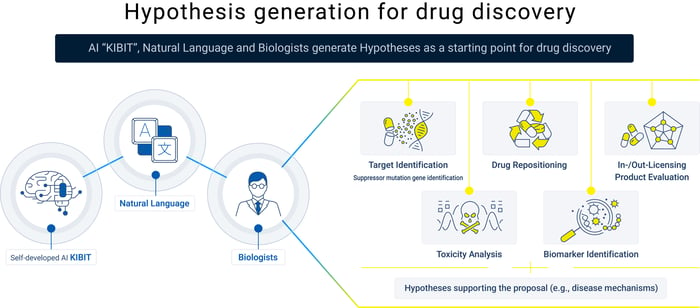
FRONTEO Drug Discovery AI Factory (DDAIF) is an AI-based drug discovery support service that combines KIBIT (patented in Japan, Europe, the U.S., and South Korea), an Equation-driven AI specialized in natural language processing, with the expertise of FRONTEO’s drug discovery researchers and AI engineers. It powerfully supports researchers’ decision-making in drug development through the analysis of disease-related gene networks and the construction of hypotheses regarding target molecule candidates. This service has already been adopted by multiple major pharmaceutical companies and has a proven track record.
*The technology used in Drug Discovery AI Factory is covered by a total of 21 patents held by FRONTEO in Japan, Europe, the U.S., and South Korea.
https://lifescience.fronteo.com/products/drug-discovery-ai-factory/
About FRONTEO, Inc. https://www.fronteo.com/en/
FRONTEO provides its proprietary Equation-driven AI "KIBIT" to support the judgment of experts in various fields who face social challenges day and night, and creates the starting point for innovation. Unlike general-purpose AI, its unique natural language processing technology (patented in Japan, Europe, the U.S., and South Korea) enables high-speed, high-precision analysis without reliance on training data volume or computational power.
Additionally, patented technology that maps (visualizes structure) analyzed information allows KIBIT to directly influence expert insights, and in recent years, KIBIT has been applied in hypothesis generation and target discovery for drug development.
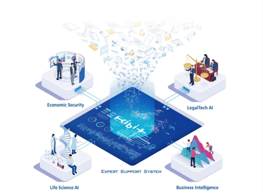
Guided by its mission to enhance fairness in the information society by uncovering opportunities and risks hidden in collective intelligence, FRONTEO promotes social implementation in life sciences AI, risk management (including economic security, business intelligence compliance support, business intelligence professional support and legaltech AI), and digital transformation support (Alnetz Inc.).
Founded in August 2003, FRONTEO was listed on the Tokyo Stock Exchange Mothers Market (now the Growth Market) on June 26, 2007. The company has offices in Japan and the U.S. As of June 30, 2026, FRONTEO’s capital stands at 915,057,000 yen.
*FRONTEO, KIBIT, and Drug Discovery AI Factory are trademarks or registered trademarks of FRONTEO in Japan, Europe, the U.S., and South Korea.