2026年07月23日

2026.02.03
Tokyo, Japan, February 3, 2026 - FRONTEO, Inc. (Headquarters: Tokyo, Japan; President & CEO: Masahiro Morimoto; hereinafter “FRONTEO”) and C4U CORPORATION (Headquarters: Suita, Osaka, Japan; President & CEO: Akimitsu Hirai, hereinafter “C4U”) have entered into a Proof of Concept (PoC) agreement with the aim of establishing a new drug discovery approach that combines FRONTEO’s AI-based drug discovery support service “Drug Discovery AI Factory” (hereinafter “DDAIF”)*1 with C4U’s genome editing technology*2.
Key Features of Both Companies and Overview of This PoC
FRONTEO possesses proprietary technology that utilizes its in-house developed AI, “KIBIT,” to discontinuously discover “unknown associations between diseases and target molecules” not documented in existing literature from vast amounts of scientific data. “DDAIF,” which is based on these technologies, excels at identifying highly novel target molecule candidates and analyzing disease mechanisms, and its adoption is expanding, particularly among major pharmaceutical companies.
C4U utilizes the next-generation genome editing technology “CRISPR-Cas3” and possesses multiple drug discovery pipelines in the fields of gene therapy and cell therapy. In addition to joint research with leading domestic research institutions such as the University of Tokyo, Kyoto University, the University of Osaka, and RIKEN, the company has built a research and business foundation in the globally prominent field of genome editing through partnerships with pharmaceutical and biotechnology companies including RACTHERA Co., Ltd. (a joint venture between Sumitomo Chemical Co., Ltd. and Sumitomo Pharma Co., Ltd.), Noile-Immune Biotech Inc., and iXgene Inc.
In this PoC, utilizing FRONTEO’s “DDAIF,” we aim to comprehensively explore diseases and targets where new drugs or treatments can be identified for disease areas difficult to treat with conventional drug modalities such as small-molecule drugs and antibody drugs, and to create new drug development pipelines for gene therapy and cell therapy that can apply C4U’s genome editing technology.
Taking intractable and rare diseases—which are difficult to treat and have high unmet medical needs*3—as an example, we will explore new treatment possibilities by integrating FRONTEO’s disease-associated gene network generation technology and screening methods with C4U’s genome editing technology.
Significance of This PoC
Genome editing technology is attracting attention primarily in areas with high global demand for therapeutic development, such as cancer, rare diseases, and intractable diseases. Meanwhile, in the field of drug discovery research,
• which diseases to target for drug development
• how to select target diseases where genome editing technology can be most effective from among the multitude of existing diseases
• and how to translate genetic abnormalities into therapeutic interventions
are key challenges that need to be addressed.
To address these challenges, FRONTEO’s “DDAIF” comprehensively analyzes vast amounts of academic literature using proprietary natural language processing algorithms. This enables the discovery of highly novel target molecule candidates and the analysis of disease mechanisms even in the field of rare diseases, where the number of published papers is limited. This capability aligns closely with the disease areas on which C4U focuses.
In this PoC, we will integrate the extraction of novel target molecule candidates and hypotheses regarding mechanisms of action using “DDAIF” with the subsequent evaluation of the applicability of C4U’s CRISPR-Cas3 technology. This integrated approach aims to advance the target discovery process in genome-editing-based drug discovery and improve the feasibility of drug development.
By organically integrating FRONTEO’s “DDAIF”-based “dry research (data analysis)” with C4U’s genome editing-based “wet research (experiments),” we aim to establish a new drug discovery model that streamlines the process from target identification to hypothesis generation and validation. Through this, we aim to achieve breakthroughs in the development of treatments for disease areas where drug discovery approaches have been difficult using conventional technologies.
About C4U’s Genome Editing Technology “CRISPR-Cas3”
Genome editing technology is a cutting-edge field attracting global attention, as evidenced by the fact that “CRISPR-Cas9” was awarded the Nobel Prize in Chemistry in 2020*4. C4U is developing “CRISPR-Cas3,” which is characterized by its ability to efficiently perform large-scale genetic modifications while offering higher selectivity compared to CRISPR-Cas9, with no off-target mutations*5 observed to date. It is expected to be a next-generation genome editing technology that balances safety and ease of use.
Comment from Akimitsu Hirai, President and CEO, C4U
“In drug discovery using genome editing, it is essential to identify the appropriate target genes associated with a disease and modify them to achieve therapeutic effects. However, beyond simply inactivating or restoring the function of disease-causing genes, there are various genes related to diseases, and their mechanisms vary widely. In this context, we expect that FRONTEO’s AI and analysis technologies will yield new insights that could not be discovered previously. KIBIT and DDAIF possess outstanding features not found in other AI technologies, and I look forward to the success of this project and the establishment of a new drug discovery model that will advance medical care.”
Comment from Hiroyoshi Toyoshiba, Director and CSO (Chief Science Officer), FRONTEO
“FRONTEO’s strength lies in its ability to use proprietary AI and analytical technologies to discontinuously identify relationships between diseases and target molecules, as well as disease mechanisms, from literature data—even those not yet reported in scientific papers. By integrating our ‘DDAIF’ with C4U’s genome editing technology, we expect to discover new possibilities for diseases and target molecules that cannot be addressed by conventional drugs or treatments. We hope this PoC will contribute to the creation of innovative genome therapies, the resolution of unmet medical needs, and the development of Japan’s pharmaceutical industry.”
Notes:
*1 DDAIF: An AI-driven drug discovery support service in which FRONTEO’s drug discovery experts, well-versed in both AI and drug discovery, leverage the natural language processing technology of FRONTEO’s proprietary AI “KIBIT” and its proprietary analytical methods to provide hypothesis generation for target molecule and indication discovery.
*2 genome editing technology: A technology that introduces artificially designed DNA-cutting enzymes into cells to selectively cut and modify specific regions of the genome.
*3 unmet medical needs: The need for new drugs, therapies, or treatment approaches for diseases for which effective treatments have not yet been established.
*4 https://www.nobelprize.org/prizes/chemistry/2020/press-release/
*5 off-target mutations: A phenomenon in gene editing where DNA other than the intended target is mistakenly edited.
About C4U CORPORATION https://www.crispr4u.jp/en/
C4U is a privately held biotech company originated from the University of Osaka, and focused on the development of safe and efficient gene therapies utilizing its proprietary next generation CRISPR-Cas3 gene editing platform.
In comparison to the CRISPR-Cas9 platform, CRISPR-Cas3 presents the distinct benefits of: 1) no off-target by the higher selectivity of deletion site (improved safety); 2) efficient knockouts by the larger deletion of gene sequences; and 3) an entirely independent patent portfolio. C4U has been granted worldwide exclusive licenses to CRISPR-Cas3 by the University of Osaka for use in eukaryotic cells thus simplifying sublicensing transactions which is in sharp contrast to the complex and heavily litigated CRISPR-Cas9 patent landscape.
C4U promotes the development of novel treatments for various diseases, including hereditary disorders, through both in-house research and collaborations with other companies, while simultaneously working to expand its CRISPR-Cas3 platform for application across a wide range of industries.
About FRONTEO Drug Discovery AI Factory (DDAIF)
[Reference: Initiatives with pharmaceutical companies and Academia]
https://www.fronteo.com/news/ddaif-list
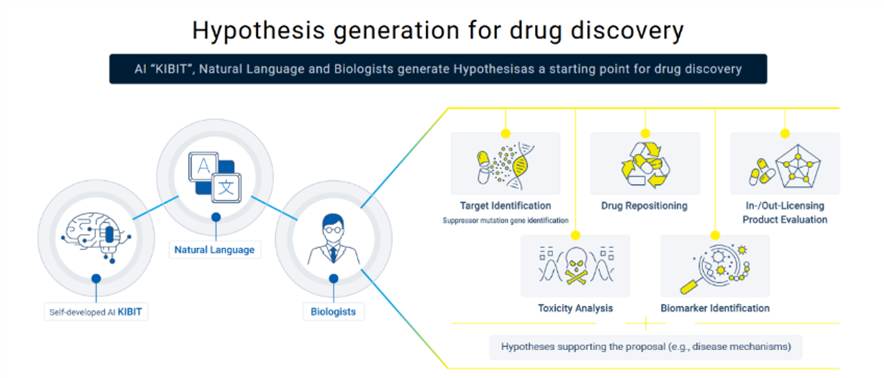
FRONTEO Drug Discovery AI Factory (DDAIF) is an AI-based drug discovery support service that combines KIBIT (patented in Japan, Europe, the U.S., and South Korea), an Equation-driven AI specialized in natural language processing, with the expertise of FRONTEO’s drug discovery researchers and AI engineers. It powerfully supports researchers’ decision-making in drug development through the analysis of disease-related gene networks and the construction of hypotheses regarding target molecule candidates. This service has already been adopted by multiple major pharmaceutical companies and has a proven track record.
*The technology used in Drug Discovery AI Factory is covered by a total of 21 patents held by FRONTEO in Japan, Europe, the U.S., and South Korea.
https://lifescience.fronteo.com/products/drug-discovery-ai-factory/
About FRONTEO, Inc. https://www.fronteo.com/en/
FRONTEO provides its proprietary Equation-driven AI KIBIT to support expert judgment across domains confronting social challenges. Its unique natural language processing technology (patented in Japan, Europe, the U.S., and South Korea) enables fast, high‑precision analysis without reliance on training data volume or computational power. Additionally, patented technology that maps (visualizes structure) analyzed information allows KIBIT to directly influence expert insights, and in recent years, KIBIT has been applied in hypothesis generation and target discovery for drug development.
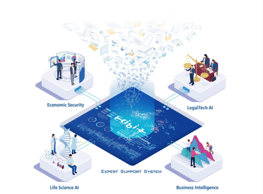
Guided by its mission to enhance fairness in the information society by uncovering opportunities and risks hidden in collective intelligence, FRONTEO applies KIBIT’s unique capabilities in life sciences AI, risk management (including economic security, business intelligence compliance support, business intelligence professional support and legaltech AI), and digital transformation support (Alnetz Inc.).
Founded in August 2003, FRONTEO was listed on the Tokyo Stock Exchange Mothers Market (now the Growth Market) on June 26, 2007. The company has offices in Japan, the U.S., and South Korea. As of March 31, 2026, FRONTEO’s capital stands at 915,057,000 yen.
*FRONTEO, KIBIT, and Drug Discovery AI Factory are trademarks or registered trademarks of FRONTEO in Japan, Europe, the U.S., and South Korea.
FRONTEO, Inc. Public Relations Department
Email: pr_contact@fronteo.com
Tel: +81-80-4321-6692
Inquiries Regarding FRONTEO Life Science AI Business
FRONTEO, Inc. Life Science AI Business Division
https://lifescience.fronteousa.com/contact/