2026年07月22日

2026.07.22
Aiming to develop drugs that meet unmet medical needs by advancing to animal testing in the future
Tokyo, Japan, May 13, 2026 - FRONTEO, Inc. (Headquarters: Tokyo, Japan; President & CEO: Masahiro Morimoto; hereinafter “FRONTEO”) conducted a validation experiment of a novel pancreatic cancer target molecule*1 candidate found by FRONTEO's AI drug discovery support service, Drug Discovery AI Factory (“DDAIF”) in the laboratory of Professor Naoko Takebe of the University of Oklahoma College of Medicine, a National Cancer Institute (NCI)-designated cancer center in the United States, with whom the company has a collaborative research partnership.
As a result, the University of Oklahoma also confirmed the cell proliferation-inhibitory effect, validating FRONTEO's previous findings*2.
In June 2025, FRONTEO began full-scale entry into the U.S.*3 and in July of the same year, the company began joint research with the University of Oklahoma*4. The results of this validation are concrete progress in that joint research.
The two parties will now advance the research to animal studies, aiming to create a new treatment option for pancreatic cancer, a disease with extremely high unmet medical needs*5.

Summary and Results of Validation Experiment
In 2025, FRONTEO used KIBIT, an equation-driven AI developed in-house, and its proprietary analysis method to find 17 genes that are candidate targets for pancreatic cancer drug discovery in just two days from among all 20,000 human genes. *2
Of these, cell growth-inhibitory effects were confirmed for six genes in cell-based tests; four of these six genes have never been reported to be associated with pancreatic cancer, and the remaining two genes are highly novel target molecule candidates, with only a single published study reported to date (as of April 19, 2025).
Among these candidate target molecules, validation experiments were conducted at the University of Oklahoma, focusing on genes that were considered effective as drug targets. As a result, experiments using various pancreatic cancer-derived cell lines showed inhibition of cancer cell growth. In particular, effectiveness was demonstrated across cell lines harboring different KRAS mutations, where significant inhibition of cell proliferation was observed.
In addition, the clinical findings of the University of Oklahoma team have suggested patient-stratified markers for the target, and hypotheses are being tested in relation to key pathways suggested by the pancreatic cancer molecular network established by KIBIT.
Future Outlook
Both parties will conduct animal studies in the future to accumulate further evidence. In parallel, the parties will continue validating hypotheses regarding the pathogenic mechanism of pancreatic cancer and accelerate research toward clinical development.
FRONTEO will implement the results in society through joint research with pharmaceutical companies and out-licensing*6, aiming to bring new treatment options to pancreatic cancer patients with limited treatment options, as soon as possible.
Comments from Dr. Naoko Takebe, Professor of Hematology/Oncology, University of Oklahoma College of Medicine

In cell-based validation experiments conducted in our laboratory, inhibition of cell proliferation was confirmed in various pancreatic cancer-derived cell lines.
At the beginning of the collaboration, the candidate target molecules discovered by FRONTEO using DDAIF were extremely novel, with few existing reports in the literature.
Because there was so little similar information, there was some skepticism among the members of our laboratory. However, I still vividly remember the moment when we confirmed the results through validation experiments—the atmosphere in the laboratory changed dramatically. Now the whole team is very excited about the research.
We are confident that these results will be a major step forward for the treatment of pancreatic cancer. We intend to accumulate further evidence through animal experiments and move forward with clinical development, hoping to deliver a new treatment option to patients as soon as possible. I look forward to working with FRONTEO to address this challenge for patients who still do not have treatment options.
Summary of Collaborative Research Between FRONTEO and the University of Oklahoma
FRONTEO and the laboratory of Naoko Takebe, Professor of Hematology/Oncology at the University of Oklahoma College of Medicine, have been collaborating since July 2025. FRONTEO will be in charge of finding candidate drug targets and generating hypotheses on disease mechanisms using DDAIF, while the University of Oklahoma will lead the validation of biological efficacy based on Professor Takebe's expertise, with the aim of efficiently identifying promising drug targets in disease areas with high unmet medical needs.
The University of Oklahoma College of Medicine is one of the nation's premier medical research institutions, home to the OU Health Stephenson Cancer Center, a National Cancer Institute (NCI) designated cancer center, where more than 300 clinical trials*7 and 400 cancer research projects*8 are currently underway.
Pancreatic Cancer: A Disease with Extremely High Unmet Medical Needs
Pancreatic cancer is known to have the lowest five-year survival rate among major cancers, at less than 10%*9. It is one of the diseases with extremely high unmet medical needs, as treatment options are limited, patients are often forced to rely on highly toxic chemotherapy drugs, and once these drugs become ineffective, there are virtually no remaining treatment options. Globally, the development of effective new treatments has been a long-standing challenge.
Biography of Dr. Naoko Takebe, Professor of Hematology and Oncology, University of Oklahoma College of Medicine
Dr. Takebe graduated from Hirosaki University School of Medicine. After internship at the Yokosuka U.S. Naval Hospital and initial training in internal medicine at Keio University, she moved to the United States. She is a board-certified physician in internal medicine, hematology, and oncology in the United States. After working as Assistant Professor of Internal Medicine and bone marrow transplantation at the University of Maryland School of Medicine, she served as Senior Investigator of the Cancer Therapy Evaluation Program at the National Cancer Institute (NCI). Since 2024, she is Professor of Hematology-Oncology, Section Chief of Solid Tumor Oncology, Associate Director of Clinical Research, Nancy Johnston Records Chair in Oncology. She is a member of the American Society of Clinical Oncology, American Association for Cancer Research, Society for Immunotherapy of Cancer, American Society of Gene and Cellular Therapy, American Society of Hematology, and American College of Physicians.
Notes:
*1 target molecule: The molecule (gene) that a drug is designed to act upon
*2 July 23, 2025, press release: FRONTEO Confirms the Cell Proliferation-Inhibitory Effect of Novel Pancreatic Cancer Target Candidates, Identified by its AI Drug Discovery Support Service “Drug Discovery AI Factory”, https://legal.fronteousa.com/resources/drug-discovery-ai-factory-pancreatic-cancer
*3 June 25, 2025, press release: FRONTEO Accelerates U.S. Expansion — Signs Strategic Partnership Agreement with U.S.-based Q Partners, a Firm with Strengths in Life Sciences and Technology, https://legal.fronteousa.com/resources/fronteo-and-qpartners
*4 July 23, 2025, press release: FRONTEO and the University of Oklahoma begin Joint Research into Drug Discovery in the Oncology Field, https://legal.fronteousa.com/resources/fronteo-and-oklahoma
*5 unmet medical needs: The need for new drugs, therapies, or treatment approaches for diseases for which effective treatments have not yet been established.
*6 out-licensing: In the pharmaceutical industry, drug development may be conducted either internally or through the acquisition of development and commercialization rights from external organizations. In the latter case, “out-licensing” refers to the granting or transfer of such development and/or commercialization rights by the originating company or institution to a pharmaceutical company.
*7 OU Health Stephenson Cancer Center, Cancer Clinical Trials, https://www.ouhealth.com/stephenson-cancer-center/cancer-clinical-trials/
*8 OU Health Stephenson Cancer Center, Cancer Research, https://www.ouhealth.com/stephenson-cancer-center/cancer-research/
*9 National Cancer Center Japan, Latest Cancer Statistics, https://ganjoho.jp/reg_stat/statistics/stat/summary.html
About FRONTEO Drug Discovery AI Factory (DDAIF)
[Reference: Initiatives with pharmaceutical companies and Academia]
https://www.fronteo.com/news/ddaif-list
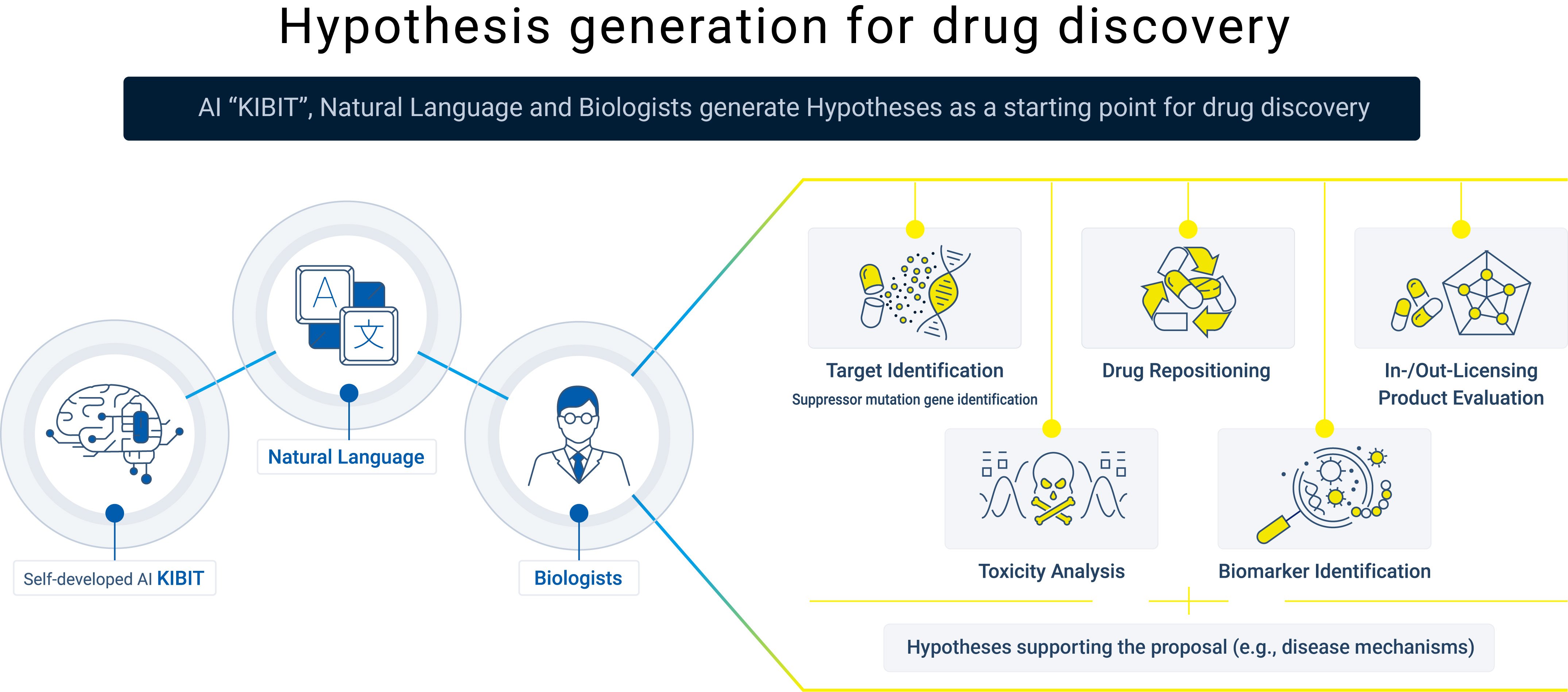
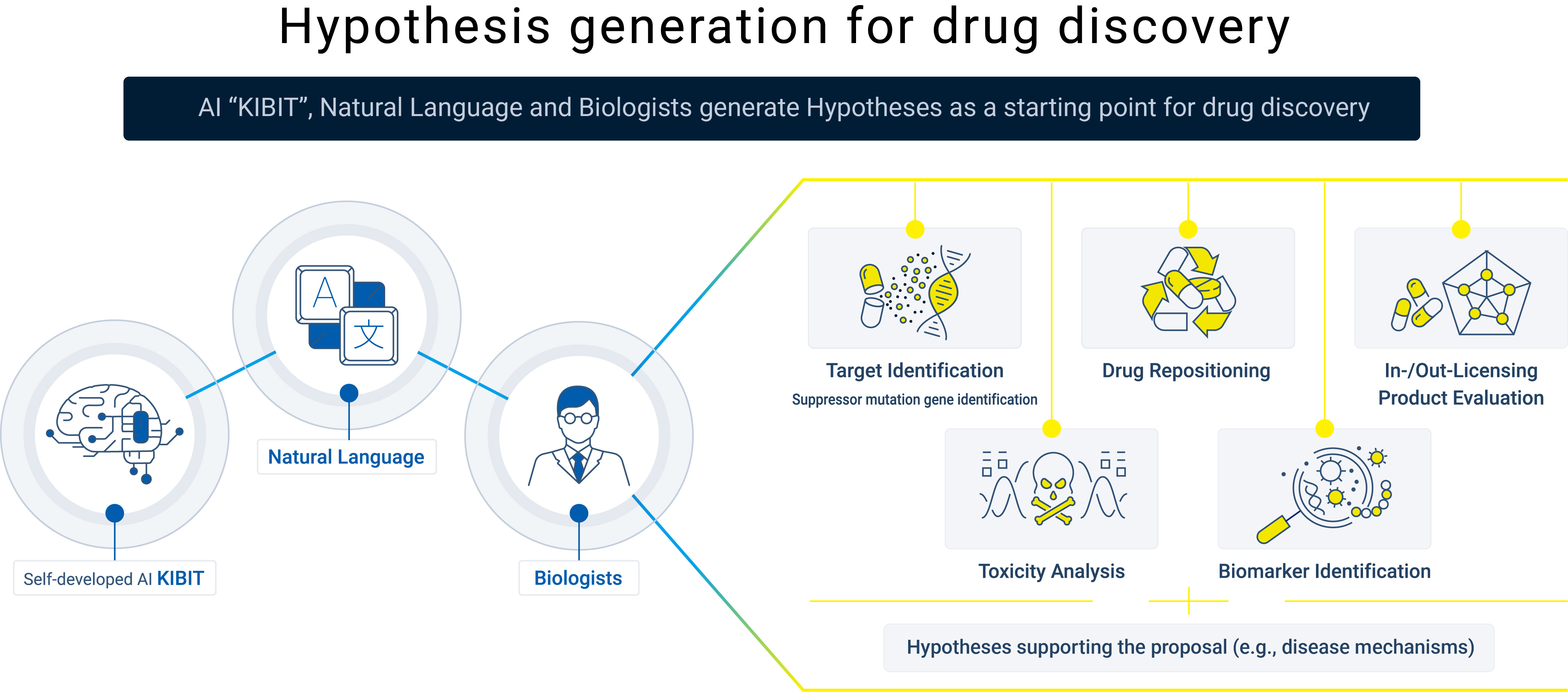
FRONTEO Drug Discovery AI Factory (DDAIF) is an AI-based drug discovery support service that combines KIBIT (patented in Japan, Europe, the U.S., and South Korea), an Equation-driven AI specialized in natural language processing, with the expertise of FRONTEO’s drug discovery researchers and AI engineers. It powerfully supports researchers’ decision-making in drug development through the analysis of disease-related gene networks and the construction of hypotheses regarding target molecule candidates. This service has already been adopted by multiple major pharmaceutical companies and has a proven track record.
*The technology used in Drug Discovery AI Factory is covered by a total of 21 patents held by FRONTEO in Japan, Europe, the U.S., and South Korea.
https://lifescience.fronteo.com/products/drug-discovery-ai-factory/
About FRONTEO, Inc. https://www.fronteo.com/en/
FRONTEO provides its proprietary Equation-driven AI "KIBIT" to support the judgment of experts in various fields who face social challenges day and night, and creates the starting point for innovation. Unlike general-purpose AI, its unique natural language processing technology (patented in Japan, Europe, the U.S., and South Korea) enables high-speed, high-precision analysis without reliance on training data volume or computational power.
Additionally, patented technology that maps (visualizes structure) analyzed information allows KIBIT to directly influence expert insights, and in recent years, KIBIT has been applied in hypothesis generation and target discovery for drug development.
Guided by its mission to enhance fairness in the information society by uncovering opportunities and risks hidden in collective intelligence, FRONTEO promotes social implementation in life sciences AI, risk management (including economic security, business intelligence compliance support, business intelligence professional support and legaltech AI), and digital transformation support (Alnetz Inc.).
Founded in August 2003, FRONTEO was listed on the Tokyo Stock Exchange Mothers Market (now the Growth Market) on June 26, 2007. The company has offices in Japan, the U.S., and South Korea. As of March 31, 2026, FRONTEO’s capital stands at 915,057,000 yen.
*FRONTEO, KIBIT, and Drug Discovery AI Factory are trademarks or registered trademarks of FRONTEO in Japan, Europe, the U.S., and South Korea.
FRONTEO, Inc. Public Relations Department
Email: pr_contact@fronteo.com
Tel: +81-80-4321-6692
Inquiries Regarding FRONTEO Life Science AI Business
FRONTEO, Inc. Life Science AI Business Division
https://lifescience.fronteousa.com/contact/