2026年10月07日

2026.10.13
Leveraging Insights from Medical and Life Science for Research in the Food and Health Sectors
Tokyo, Japan, October 13, 2026 - FRONTEO, Inc. (Headquarters: Tokyo, Japan; President & CEO: Masahiro Morimoto; hereinafter “FRONTEO”) is pleased to announce that Suntory Global Innovation Center Limited (Headquarters: Tokyo, Japan; President & CEO: Susumu Takemoto; hereinafter “Suntory Global Innovation Center”), which is responsible for fundamental technology research within the Suntory Group, has adopted the medical paper search AI “KIBIT Amanogawa.”

Background and Purpose of Adoption
In recent years, as research subjects in the food and health sectors have become increasingly complex and research data has diversified, it has become even more important in research and development to identify useful insights from scientific information and use them to generate new, evidence-based ideas and hypotheses. KIBIT Amanogawa supports these research activities by comprehensively analyzing medical and life science research papers and identifying relationships that would be difficult to uncover using conventional approaches alone.
Suntory Global Innovation Center is responsible for research and technological development aimed at enhancing value and driving business growth across the entire Suntory Group. The company decided to adopt KIBIT Amanogawa for use in research activities that explore medical and life science research papers to generate new ideas and hypotheses.
Features of KIBIT Amanogawa and Its Application to the Food and Health Sectors
“KIBIT Amanogawa” is an AI system that utilizes the natural language processing technology of “KIBIT”*1—an equation-driven AI developed in-house by FRONTEO—to analyze a corpus of over 40 million medical and life science research papers in a comprehensive and unbiased manner. Through a “discontinuous discovery” approach that identifies associations not directly stated in papers, it supports the discovery of new insights and relationships between phenomena that could not be identified through conventional literature searches. To date, it has been used primarily in drug discovery research at pharmaceutical companies and academic institutions, focusing on the exploration of unknown associations between diseases and target molecules*2 and the generation of hypotheses regarding mechanisms of action. Currently, its application is expanding to companies and other organizations across a wider range of fields, including food and health, cosmetics, and materials.
Comment from Hiroyoshi Toyoshiba, Director and CSO (Chief Science Officer), FRONTEO
“To generate new discoveries in research and development, it is crucial to link diverse data and existing knowledge and identify previously unseen relationships. Insights from medical and life science research papers may lead to new ideas and hypotheses.
I hope that KIBIT Amanogawa’s ‘discontinuous discovery’ will help open up new research possibilities for Suntory Global Innovation Center, leading to the creation of new value and improvements in people’s quality of life (QOL).”
FRONTEO will further advance the expansion of KIBIT’s scientific information analysis—developed through drug discovery research—into the food and health sectors. FRONTEO will continue to expand the application of KIBIT Amanogawa beyond pharmaceuticals to include the food, health, cosmetics, and materials industries, supporting “discontinuous discoveries” and the creation of new value in each of these fields.
Notes:
*1 Equation-driven AI “KIBIT”: An artificial intelligence independently developed by FRONTEO. By utilizing mathematical equations, KIBIT enables discontinuous discoveries, identification of causal relationships, and highly accurate, reproducible analyses. Its lightweight learning process enables fast, high-precision analysis at the CPU level.
*2 Target molecule: A molecule (gene) targeted by a drug for its activity.
About KIBIT Amanogawa https://lifescience.fronteo.com/products/amanogawa/
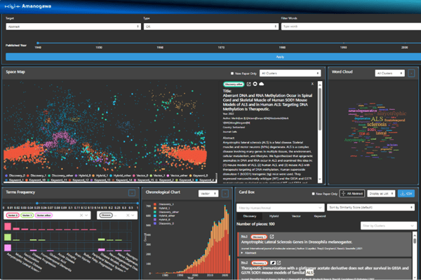
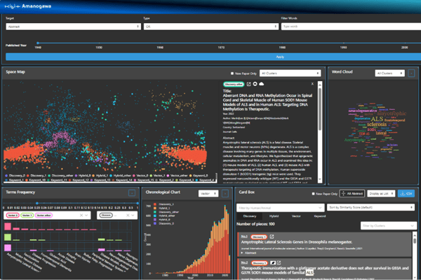
KIBIT Amanogawa system interface. The dots displayed on the “Space Map” in the upper-left corner represent individual academic papers.
“KIBIT Amanogawa” is a medical paper search AI system that utilizes FRONTEO’s proprietary natural language processing technology.
It comprehensively and unbiasedly analyzes a database of over 40 million research papers and is characterized by its “discontinuous discovery” approach, which uncovers unreported associations not explicitly stated in published papers. To date, it has been utilized primarily by pharmaceutical companies to explore unknown associations between drug target molecules and diseases, as well as to generate hypotheses regarding mechanisms of action. This technology can also be applied to research and development across a wide range of fields, including cosmetics, healthcare, food, and materials.
About FRONTEO, Inc. https://www.fronteo.com/en/
FRONTEO provides its proprietary Equation-driven AI "KIBIT" to support the judgment of experts in various fields who face social challenges day and night, and creates the starting point for innovation. Unlike general-purpose AI, its unique natural language processing technology (patented in Japan, Europe, the U.S., and South Korea) enables high-speed, high-precision analysis without reliance on training data volume or computational power.
Additionally, patented technology that maps (visualizes structure) analyzed information allows KIBIT to directly influence expert insights, and in recent years, KIBIT has been applied in hypothesis generation and target discovery for drug development.
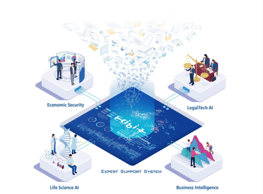
Guided by its mission to enhance fairness in the information society by uncovering opportunities and risks hidden in collective intelligence, FRONTEO promotes social implementation in life sciences AI, risk management (including economic security, business intelligence compliance support, business intelligence professional support and legaltech AI), and digital transformation support (Alnetz Inc.).
Founded in August 2003, FRONTEO was listed on the Tokyo Stock Exchange Mothers Market (now the Growth Market) on June 26, 2007. The company has offices in Japan and the U.S. As of June 30, 2026, FRONTEO’s capital stands at 915,057,000 yen.
*FRONTEO, KIBIT, Amanogawa, and Drug Discovery AI Factory are trademarks or registered trademarks of FRONTEO in Japan, Europe, the U.S., and South Korea.